


The Life Changing Work Of Grace
Updated: Oct 2

There is a corner of my inner garden I have returned to more times than I can count, certain each time that this visit would be the last.
I would clear it, turn the soil, plant something new, and walk away believing the work was finished. A season would pass, sometimes two, and I would find myself kneeling in that same patch of earth, hands in the same soil wondering why I was back.
You know this corner.
I am almost certain of it. There is a place in you that you have worked and reworked, a wound you were sure you had closed only to find yourself standing in front of it again.
Consider that somewhere along the way you may have decided this says something about you. That you are slow. That other people finish this kind of thing and you for some reason cannot.
It took me years to understand that going back was never the failure I believed it was.
The programs we build out of shame
So much of what passes for personal growth begins in a quieter and sadder place than we like to admit. We look at our lives and see something to fix, something incomplete, something not yet enough, and we mistake that feeling for insight when it is usually shame wearing the costume of ambition.
Comparison hands us a picture of the person we were told we should be and we set out to become it. We build the program, schedule the discipline, set the targets, and never once pause to ask who led us to do it.
The trouble with these self appointed renovations is that behaviour quietly becomes more important than being. Once that trade is made the fixing stops being a path and becomes a prison in the form of a life quenching space, where we spend ourselves chasing a perfection that moves further away every time we draw near.
When we undertake this journey out of performance we are rarely interested in the longer path of healing. Our motivation is not to heal and understand as much as it is to fix and move on, because performance has no patience for seasons.
It wants the wound closed, the box ticked, and the evidence of progress it can point to so it hurries us past the very ground where the deeper work was waiting to be met.
Inevitably there is no rest inside a project that was never designed to be finished. So the striving does what striving always does in the end.
It burns us out.
I have watched this happen to capable, devout, and well meaning people for over thirty years. This is the quiet way so many of them drift from the very life they were created for.
Sadly, somewhere along the road they came to believe that grace was inviting them to fix themselves when the journey was never about fixing at all.
We discover this the moment we take the deck of our own lives into our hands and beg God to reshuffle it. To remove the cards we cannot bear and deal us the life we wish we had been given. When we do this sooner or later we will hear what Paul heard when he pleaded for his thorn to be taken away.
"My grace is sufficient for you."
When God says this, he is often telling us that he has no intention of changing the very area we are most bothered and ashamed of. This is not neglect. It is in fact an invitation to see that our worth and our standing were never supposed to be determined by our flaws and broken spaces nearly as much as by who we are in our true selves.
It also settles something we spend enormous energy fighting. If God wants to heal or change something in our lives he will make us aware of it. If he does not, we can rest assured that his grace is sufficient in that place, and that trying to change it ourselves will usually lead us into more frustration and pain, because our forcing does more harm than good.
Paul carried his thorn to the end of his life. Therefore with this in mind consider that the parts of ourselves we find dirty and shameful, as he did, are often the very parts God uses to fertilize the seeds of life within us because our lives need balance, and let us be honest about it.
There has never been a great harvest without shit.
This is why grace does not always change the circumstances we are desperate to have changed. It does something deeper. It meets us in the middle of them and there it teaches us that the life we have been fighting to escape may be the very place where God has been waiting to find us all along.
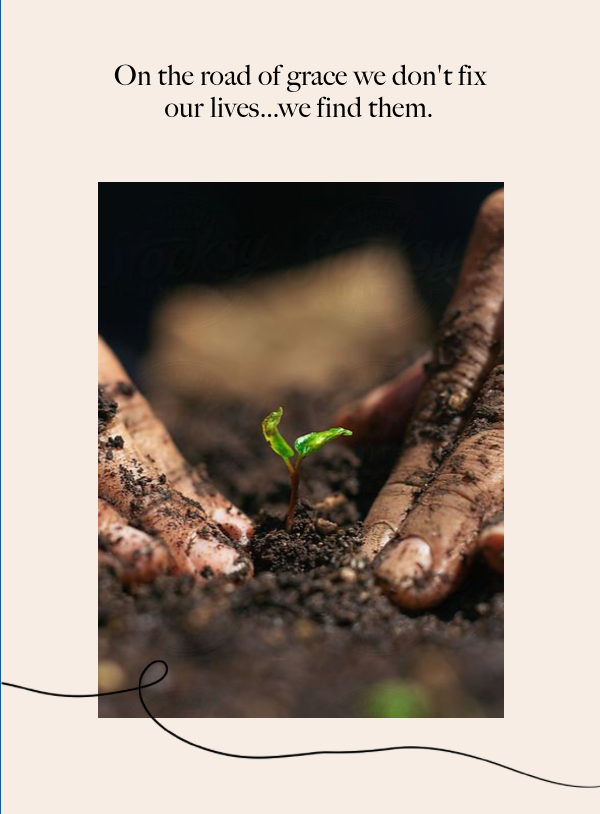
Always remember that on the road of grace we do not fix our lives.
We find them.
Why the path circles back?
When healing is genuine and is led by the heart rather than driven by willpower, it rarely moves in a straight line. Instead it moves in seasons and often in circles.
There are places in me I have walked through more than once, and every time I have been led back I have understood something I could not have understood the first time. The healing that met me there went deeper than it had gone before precisely because I was finally ready for it.
I used to believe that returning to old ground meant I had failed to finish something. Now I understand it means I am ready to receive more of what was always waiting there for me.
This is why we can move on from these places in gratitude, carrying a real and deeper healing with us, while staying open to the possibility that one day we will be led back to complete what still remains.
This is not a flaw in the process. This is the process.
Something else also grows in this rhythm that a straight line could never produce. A relationship forms with ourselves and with the divine presence walking within us. Because circle by circle we learn to trust that if more healing is needed we will be guided there when the time is right.
Our part in the meantime is simply to stay present and surrendered responding to what is actually in front of us, rather than to what we imagine should be finished by now.
Nobody does this well alone. The circling is where most people give up, not because the ground is too hard, but because there is no one kneeling beside them inviting them to see that this is normal and it is safe to stay.
That is the whole of what I do. I sit with people in the corner of the garden they are ashamed of and help them stay long enough for the ground to speak.
When curing comes
Now there is another way God moves in us, and it looks nothing like this slow circling.
We see it all through the life of Yeshua, who so often paused in front of a suffering person and asked them directly what they wanted him to do for them. When curing comes it is complete and it is often immediate. It does not ask us to walk the same ground again next season.
In my experience, even though the majority of us crave the cure, curing rarely arrives where we are looking for it. Instead it tends to come as the unannounced byproduct of an ongoing journey of healing.
We are faithfully tending one wound when an old and deep seated trauma connected to it suddenly lifts and is released, cured while our attention was elsewhere.
This is worth sitting with because it tells us something we spend most of our lives resisting. It is God who decides whether we are healed or cured.
There is nothing we can do to make it so. Our striving has never once been the deciding factor and the day we truly believe that, is the day we can finally rest and receive what God has planned for us individually.
The Return to Eden
Now here is what I ultimately want to invite you to see and, in time, understand.
Beneath both of these movements runs a single journey which leads us back to where our lives actually begin which is our heart.
I believe each of us carries a Garden of Eden inside planted before shame ever had a word to say about who we were. I believe it is into this garden that Yeshua walks us back every time we respond to his invitation to follow him. I have come to believe this with my whole life, so much so that I wrote a book about it called The Modern Fig Leaf.
In the end it is grace that facilitates the healing and not our striving. Yet grace is very hard to trust until we have actually felt it carry us. Especially through the shame and often the blind judgement of others that disabled us for so long.
This is why I ask the people I work with one question before anything else. Not what do you want to heal, but where do you keep going back.
I think of that corner of my garden differently now. I no longer see a failure I keep returning to or a patch of ground that stubbornly refuses to become what I want it to be.
I see a place where every time I kneel something new is being planted in me. I no longer need to know how many seasons remain before the work is finished, because I am learning to trust the hands that are doing the planting.
Perhaps that is what grace has been teaching me all along. Not to measure my life by how finished it looks but by whether I am willing to kneel, trust, and believe that the One who began the work is capable and more than able, to bring me into a reality where I can embrace and accept what he has already finished.
My inner garden is definitely not finished and neither am I.
Yet, for the first time, I can see with confidence that this is not so much a failure as much as it is Gods design and the patient product of grace at work.
With you on the journey,

PS If you recognised your own corner somewhere in these lines, reply to this email and tell me where you keep going back. I read every one, and sometimes that one sentence is the beginning of the whole conversation.


Comments